

Why Most Students Are Not Proficient In Reading And Math

According to the National Center for Education Statistics, school principals estimated that 40% of public-school students began the 2024–25 school year behind grade level in at least one academic subject. Among schools reporting students who were behind, 98% reported that students were behind in mathematics and 98% reported students behind in English/language arts.
The national assessment data tell a similar story. In 2024, only about 31% of fourth graders performed at or above the NAEP Proficient level in reading, while 40% performed below NAEP Basic. In eighth-grade reading, approximately one-third of students performed below NAEP Basic.
And the situation is particularly concerning in some large urban districts.
In Detroit, for example, the 2024 NAEP results showed that only 6% of eighth-grade students performed at or above the NAEP Proficient level in reading, while 35% performed at or above NAEP Basic. In eighth-grade mathematics, only 4% performed at or above NAEP Proficient, while just 20% performed at or above NAEP Basic.
These numbers do not mean that every Detroit student—or every student in an urban school—is several grade levels behind. They do, however, demonstrate that a substantial number of students are entering and progressing through middle school without demonstrating the foundational reading and mathematics skills expected on these assessments.
And that should make all of us stop and ask a very simple question:
What are we actually doing to close the gaps?
The field of education is inundated with catchphrases such as “data-driven decision making,” “differentiated instruction,” “student-centered learning,” “high-quality curriculum,” and “accelerated learning.” These concepts can have value. But terminology does not teach a child to read, solve a multi-step mathematics problem, understand fractions, write a coherent paragraph, or comprehend grade-level text.
Teachers know this.
The reality of the classroom is considerably more complicated than many educational initiatives make it sound.
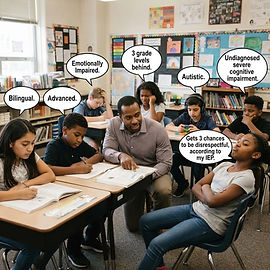
A teacher may be responsible for 25 or more students whose instructional needs are dramatically different. Within the same classroom there may be students who are multilingual learners, students receiving special education services, students with significant unfinished learning, students who struggle with attention or executive functioning, students who are unable to read independently, and students who are already performing above grade level and need additional challenge.
Then we tell that teacher to differentiate.
But differentiate what, exactly—and for whom?
How does one teacher effectively deliver an eighth-grade reading lesson to a class in which some students are reading substantially below grade level, while simultaneously providing appropriate support to students who cannot independently access the text and meaningful enrichment to students who have already mastered the skill?
It is not impossible to differentiate instruction.
But we should stop pretending that differentiation eliminates the need for additional adults.
Teachers Cannot Be Expected to Do Everything Alone
This is where the conversation about interventionists becomes important.
The evidence does not support the idea that teachers simply need another training session, another initiative, another online platform, or another program added to an already crowded school day.
In fact, staffing itself is part of the problem.
NCES reported that 21% of public schools had multiple teaching vacancies in October 2023, with shortages more prevalent in high-poverty schools and schools serving primarily students of color. Schools also reported vacancies among non-teaching personnel, including tutors and classroom aides.
RAND’s research similarly documents the strain on teachers. In its 2024 State of the American Teacher survey, 60% of teachers reported burnout and 59% reported frequent job-related stress. That matters because teacher morale and instructional capacity cannot be separated from the conditions in which teachers are expected to work.
Teachers are the wheels on the bus when it comes to improving student achievement.
But right now, too many of those wheels are losing their tread—and losing air.
The tread is the ability to consistently deliver effective instruction under increasingly complex conditions. The air is the morale, energy, time, and physical and emotional stamina required to keep doing it. And when the wheels begin to fail, telling the driver to press harder on the accelerator does not solve the problem.
We Need More Qualified Adults Providing Direct Instruction
This is why I believe the conversation needs to move beyond “What training do teachers need?” and toward “What additional instructional capacity do teachers and students need?” There is an important distinction.
Professional development can help teachers improve their practice. Curriculum can provide structure. Technology can provide additional practice. Assessments can provide information.
But none of those things changes the fundamental adult-to-student ratio.
If 25 students have significant differences in their academic needs, one teacher remains one adult.
Adding a qualified interventionist changes that equation.
Adding a trained tutor changes that equation.
Adding a reading specialist, mathematics interventionist, paraprofessional, or other appropriately qualified instructional professional changes that equation.
Research on high-dosage tutoring provides important evidence for this approach. The Institute of Education Sciences describes high-quality tutoring as typically involving frequent sessions, small groups or one-to-one instruction, trained tutors, and alignment with the school’s core curriculum. A synthesis of 96 tutoring studies found tutoring to be an effective practice with consistent positive effects on learning outcomes.
The federal data also show that schools recognize the need for additional instructional support. In 2023–24, 82% of public schools reported offering some form of tutoring, and 39% reported offering high-dosage tutoring. But there is another important piece of that data: schools also report difficulty funding the staff necessary to provide these services. In earlier NCES data, nearly half of schools offering high-dosage tutoring reported that lack of funding to hire staff limited their efforts.
So perhaps the question should not be whether additional instructional support works.
Perhaps the question should be whether we are willing to invest enough in qualified people to provide it well and consistently.
“Growth” Is Not the Same Thing as Learning
As I stated in a previous blog, “Growth on achievement data does not equal learning.”
Let me be clear: growth data have value. Measuring progress can tell us whether a student is moving in the right direction. But growth should not become a substitute for asking whether students have actually acquired the knowledge and skills they need. A student can make measurable growth and still be substantially below the level of performance expected for his or her grade. That distinction matters.
If a student begins the year significantly below grade level and makes progress, we should celebrate that progress.
But we should also ask:
What does the student know now?
What can the student independently do now?
What foundational skills are still missing?
What does the student need next?
Those questions get us closer to actual learning.
And, keep in mind, standardized assessment data have limitations. NAEP, for example, provides valuable national, state, and district information, but its achievement levels are specific to the NAEP assessment and are not intended to serve as a direct definition of grade-level proficiency for every state or district. That is precisely why educators need multiple sources of evidence—including classroom work, curriculum-aligned assessments, diagnostic information, observations, and direct demonstrations of student learning.
If an assessment is not aligned with what students have been taught, educators have to ask exactly the question I have asked before:
How sway?
Translation:
How did you determine that?
Teachers Must Be Part of the Solution
Teachers have been trained to teach.
Teachers have been trained to identify student needs.
Teachers spend every day observing how students respond to instruction.
They know which students are struggling with decoding.
They know which students can read words but cannot comprehend what they read.
They know which students can perform basic computation but struggle when mathematics becomes conceptual.
They know which students need additional repetition.
They know which students need a different explanation.
They know which students need acceleration.
And they know when something being implemented in the classroom is simply not working.
That knowledge should not be dismissed.
Teachers should be respected as professionals and included meaningfully in decisions about curriculum, intervention, assessment, scheduling, and instructional priorities. And, most importantly, teachers should be included in discussions about how students learn and they should be invited to participate in decisions related to what should take place in the classroom, as it relates to teaching practices that impact real learning.
But respecting teachers does not mean expecting them to solve every problem alone.
“Grade-Level Curriculum” Cannot Mean “Ignore the Gaps”
I am not arguing that students who are behind should simply be removed from grade-level instruction indefinitely. In fact, current research on accelerated learning emphasizes the importance of connecting students to grade-level content while addressing unfinished learning. The Institute of Education Sciences distinguishes acceleration from simply remediating students through large amounts of lower-grade content.
The issue is how we accomplish both things simultaneously.
A student can be exposed to grade-level content while receiving targeted instruction addressing the prerequisite skills necessary to access that content.
But again:
Who is providing that additional instruction?
If the answer is always “the classroom teacher,” we need to acknowledge the enormous demands we are placing on one person. Imagine an eighth-grade classroom in which students
have five different instructional starting points.
Now imagine asking the teacher to:
Teach the grade-level standard.
Identify unfinished learning.
Provide differentiated instruction.
Conduct small-group instruction.
Provide individualized support.
Monitor accommodations.
Manage behavior.
Assess learning.
Analyze assessment data.
Communicate with families.
Maintain classroom routines.
Challenge students who are already proficient.
And somehow find the time to reteach foundational skills to students who are several years behind.
Every day.
That is not a theoretical scenario.
That is the reality many teachers experience.
Something Has Got to Give
One of the most encouraging findings in the current research is that school leaders themselves recognize the value of additional intervention. RAND research found that district leaders identified tutoring, summer programming, and academic interventionists among the interventions they viewed as most useful for helping students recover academically after the pandemic.
That should get our attention.
Because the solution is not necessarily another acronym.
It is not necessarily another initiative.
It is not necessarily another online program.
And it certainly cannot be another mandate placed on teachers without additional capacity.
We need additional, qualified people in classrooms.
We need interventionists who understand literacy.
We need mathematics interventionists who understand foundational numeracy.
We need trained tutors who can work consistently with small groups.
We need paraprofessionals and instructional support personnel who are appropriately prepared for the students they serve.
And we need to structure schools so that classroom teachers are not expected to simultaneously be classroom teacher, interventionist, reading specialist, mathematics specialist, behavior specialist, data analyst, curriculum implementer, and technology coach.
Our Students Deserve the Investment
Our students are not data points.
They are not percentages.
They are not proficiency bands.
They are children with enormous intellectual potential.
The 2024 NAEP results make clear that the academic challenges facing public schools are substantial. Detroit’s results make that reality even more visible. At the same time, the research tells us that targeted, high-quality tutoring and additional instructional support can be part of an effective response. So instead of spending millions upon millions of dollars on disconnected programs, platforms, initiatives, and professional development that may not address the actual instructional problem in front of us, perhaps we need to ask a different question:
What would happen if we invested that money in qualified people?
What if every classroom teacher had meaningful access to qualified interventionists?
What if students who were significantly behind received frequent, targeted instruction from trained professionals?
What if teachers had the time and support necessary to collaborate around actual student learning?
What if the people making instructional decisions regularly listened to the people standing in front of students every day?
And what if we stopped measuring our success primarily by whether students demonstrated “growth” and started asking whether they actually learned the skills they need to become proficient, independent learners?
Something has got to give.
Not because teachers do not care.
Not because students cannot learn.
And not because schools lack people who are trying.
Something has to give because the current level of unfinished learning demands a level of instructional support that one teacher, standing alone in a classroom, cannot reasonably be expected to provide to every student simultaneously.
One thing about us teachers:
We love our students, regardless of our working conditions.
But love is not a staffing model.
Passion is not an intervention plan.
And another initiative cannot substitute for another qualified adult.
Our students’ untapped genius deserves more.
Our teachers deserve more.
And the time to rethink how we provide meaningful instructional support is now.
What are your thoughts?



Comments